When it comes to reducing energy costs in poultry production, upgrading ventilation is one of the highest-impact investments a broiler farmer can make. But how significant are the gains in practice, and do laboratory claims hold up in a real barn, across a full year of production cycles?
This case study documents the results of an on-field comparison between two ventilation systems installed in twin broiler barns in Italy, monitored over 10 consecutive flocks starting October–November 2023.
The setup: two identical barns, two different fan technologies
The customer operates two twin broiler barns, each measuring 120×16 meters. The barns are structurally identical, allowing for a clean head-to-head comparison of ventilation performance and energy consumption.
Each barn was equipped with 10 exhaust fans, but of different technology:
- Conventional barn: 10 × Saturn ONE HE 1.5 hp IE3 efficiency, a proven, energy-efficient 55″ cone belt-driven fan
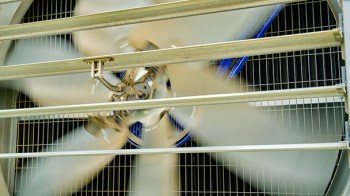
- High-efficiency barn: 10 × Saturn FIVE direct-drive 3-blade E-line fan, latest-generation variable-speed technology, equipped with EC motor.
The electricity consumption was measured in both barns throughout the entire monitoring period.
Energy saving results: electricity
39%: Average yearly electricity saving
44–45%: Saving in winter, spring & autumn flocks
36%: Saving during summer flocks
~10,000 kWh: Cumulative saving after 7 flocks
The high-efficiency barn consistently consumed less electricity across all seasons. Percentual savings were highest during winter, spring, and autumn flocks, reaching 44–45%, where the variable-speed E-line fans operate efficiently with propeller speed regulation. During summer flocks, when fans run at or near full capacity more frequently, the saving was 36%, still substantial.
The most striking data point is the cumulative saving: by flock 7, the E-line barn had already saved approximately 10,000 kWh of electricity compared to the conventional barn, with individual summer flock savings peaking at around 2,900 kWh per flock.
Animal performance: FCR not compromised
A common concern when modifying ventilation systems is the potential impact on animal welfare and production performance. In this case study, both barns reported similar feed conversion ratio (FCR) values. Notably, the high-efficiency barn with E-line fans showed a slight advantage in FCR performance, suggesting that variable-speed control may provide marginally better environmental conditions for the birds.
Why do E-line fans deliver these results?
The performance gap seen in this case study comes down to how the two technologies respond to ventilation demand. Belt-driven fans operate at fixed speeds, delivering a set airflow regardless of what the barn actually needs at any given moment. E-line fans with EC motors adjust speed continuously in response to real-time conditions.
The Saturn Five E-line delivers extremely high energy efficiency ventilation thanks to the big diameter conveyor, theory says that, given a certain ventilation capacity, if it is exhausted by a bigger diameter fan it results in a lower energy consumption.
In practice, ventilation demand in a broiler barn is at its peak only during summer flocks. For the majority of the production cycle, winter, spring, and autumn, fans run at lower rates. A variable-speed fan operating at partial load consumes significantly less energy than a fixed-speed fan running at or near full capacity. This explains both the higher savings in cooler months (44–45%) and the more modest but still substantial savings in summer (36%).
These results reflect the specific conditions of this installation. Outcomes will vary depending on barn size, climate, flock density, and management practices.
Conclusion: a compelling business case for fan upgrades
This case study demonstrates that upgrading from efficient belt-driven fans to latest-generation E-line direct-drive fans delivers measurable, documented savings: a 39% average reduction in electricity consumption in winter. With peak savings of nearly 2,900 kWh per summer flock and cumulative savings reaching 10,000 kWh within 7 flocks.
The fact that these results were achieved with no negative impact on FCR, and a slight improvement, makes the upgrade argument even stronger for farmers and technical advisors evaluating ventilation modernization.
Request information on products and applications