Energy costs are one of the main operational concerns in modern broiler production. As electricity prices continue to rise, producers increasingly focus on improving the energy efficiency of poultry house ventilation systems.
When electricity bills increase, the first reaction is usually to question the efficiency of existing equipment:
- Are the fans efficient enough?
- Should we upgrade to a newer fan?
- Would EC technology (variable speed) reduce consumption?
- If so, how much energy saving can we realistically expect?
To answer these questions, the first step is understanding where energy is actually used inside a broiler house.
Electrical vs Thermal Energy in poultry houses
Broiler houses consume both electrical energy and thermal energy to maintain proper climate conditions for the birds.
The ratio between thermal and electrical consumption varies depending on several factors:
- Climate conditions
- Season
- Ventilation strategy used inside the poultry house
Understanding how ventilation works across different production phases is essential for identifying where energy savings are possible.
Energy use across different ventilation stages
Minimum ventilation
During minimum ventilation, the objective is to remove humidity and harmful gases while maintaining stable temperatures.
At this stage, it is essential to ventilate as much as required to guarantee air quality for the birds, without unnecessarily increasing energy consumption.
Here, variable speed fans provide significant benefits because they can operate at lower propeller speeds, reducing both:
- electrical energy consumption
- thermal energy loss
Transition ventilation and early tunnel ventilation
During transition ventilation and the first stages of tunnel ventilation, the potential for energy savings becomes even greater.
In these conditions:
- static pressure is relatively low
- fans can run at reduced propeller speed
This allows variable speed fans to save a large amount of electrical energy while still delivering the required airflow.
Full tunnel ventilation
During full tunnel ventilation, fans typically operate at maximum speed to ensure sufficient air velocity for bird cooling.
At this stage, the potential for energy savings becomes minimal because:
- all fans run at full capacity
- speed modulation is rarely used
The key parameter: specific performance of a fan
To properly evaluate fan efficiency, it is important to introduce a key parameter called specific performance.
Specific performance measures how efficiently a fan delivers ventilation capacity relative to its power consumption.
In simple terms, it indicates:
How many cubic meters of air a fan can deliver per watt of electrical power.
The higher the value, the more efficient the fan.
How static pressure affects fan efficiency
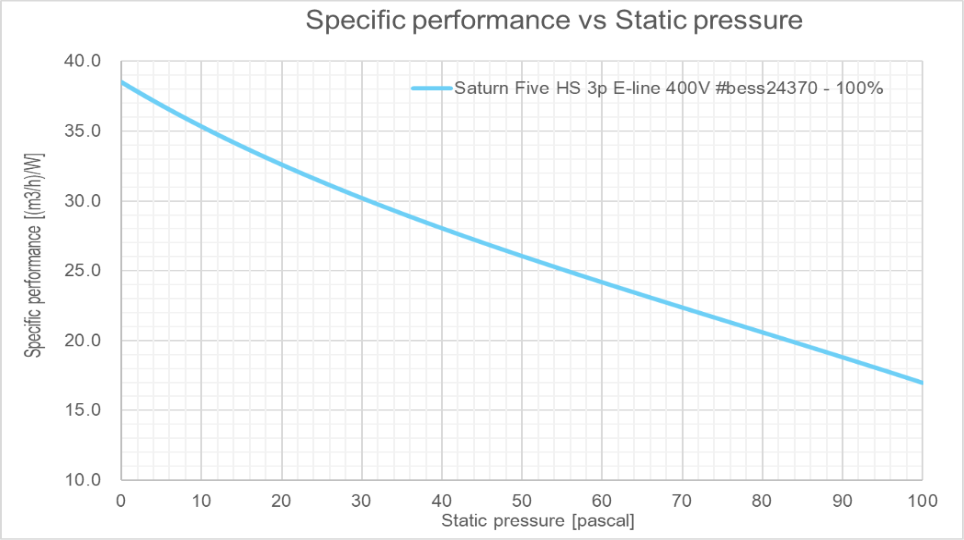
Specific performance is not a fixed value for a fan.
It changes depending on static pressure inside the building.
This is intuitive: extracting air against 100 Pa of negative pressure requires significantly more energy than extracting air against 20 Pa.
Typically, as static pressure increases:
- specific performance decreases
This relationship is usually represented by a curve where:
- static pressure increases along the X-axis
- specific performance decreases along the Y-axis
What happens when fan speed changes?
Another important factor influencing fan efficiency is propeller speed.
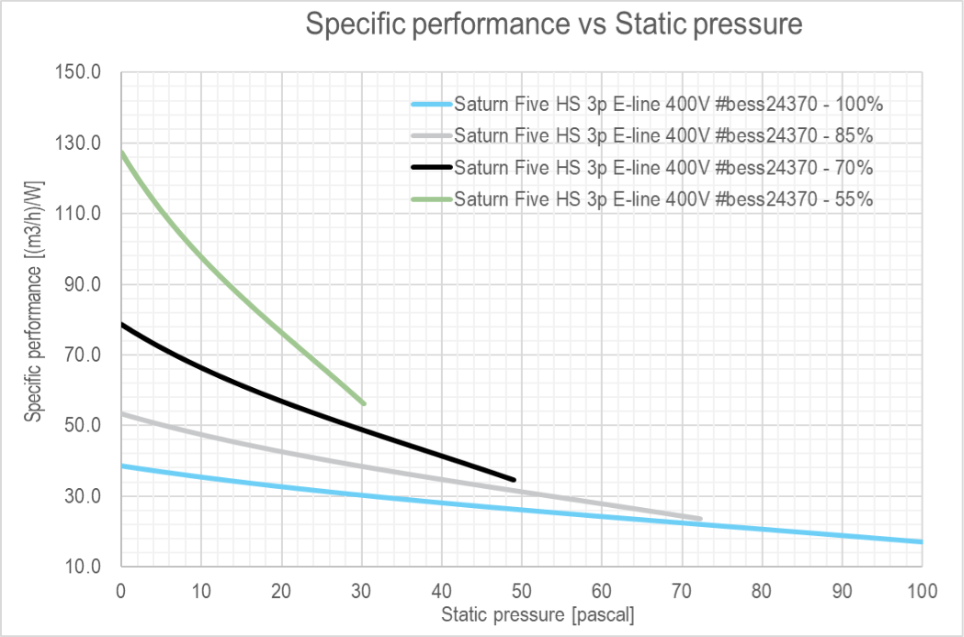
Each fan speed corresponds to a different specific performance vs pressure curve.
When the propeller speed decreases, the specific performance increases, especially when fans operate at low static pressure (for example around 20 Pa, typical during minimum ventilation).
This means that:
- lower fan speed
- lower static pressure
together create the most efficient operating conditions.
For this reason, it is essential to identify the optimal propeller speed that maximizes specific performance based on:
- ventilation demand
- static pressure inside the building
Case study: energy savings in an Italian broiler farm
Theory and practice come together in a real case study from a broiler farm in Italy.
The customer decided to improve the efficiency of one of his broiler houses by replacing part of the existing ventilation system.
The upgrade involved replacing some EM50 1.0 hp fans with EC50 fans from the E-line, combined with a monitoring system to track energy consumption.
The farm operates two identical broiler houses (99 × 14 m) equipped with different ventilation systems.
Standard barn
- 12 × EM50 1.0 hp fans
High-efficiency barn
- 3 × EC50 E-line fans
- 9 × EM50 1.0 hp fans
Both barns were monitored over 10 flocks, measuring electricity and fuel consumption.
Measured electricity savings
The results showed significant reductions in electricity consumption.
Measured savings were:
- 40% electricity savings during winter flocks
- 15% electricity savings during summer flocks
The higher savings during winter and mid-season flocks are explained by lower ventilation demand.
In these conditions, fans operate more frequently at reduced propeller speed, maximizing the energy efficiency of the system.
During summer flocks, ventilation demand increases significantly. As a result, fans operate at higher speeds for longer periods, reducing the potential for speed modulation.
However, the savings remain substantial.
Over approximately 3 flocks, the customer saved about 2600 kWh, equivalent to 24% compared to the standard shed.
Additional savings: reduced fuel consumption
Electricity savings were not the only benefit observed.
The farmer also reported lower fuel consumption in the barn equipped with Saturn Five E-line fans.
After 7 flocks, the farm recorded savings of approximately:
1600 kg of LPG
These additional savings were achieved thanks to more stable and continuous ventilation, which helped maintain better climate conditions while reducing heating demand.
Want to estimate how much energy your poultry house ventilation system could save?
Use our E-Line Energy Saving Calculator to simulate potential reductions in electricity consumption based on your barn configuration.