Evaporative cooling systems are designed to provide effective and energy-efficient temperature control in livestock buildings, greenhouses and other agricultural facilities.
However, their performance depends heavily on the condition of the cooling pads and the water distribution system.
Dust, mineral deposits, algae and clogged water openings can reduce airflow, create uneven wetting and decrease cooling efficiency. Regular evaporative cooling pad maintenance therefore helps preserve system performance, extend component life and reduce the risk of unexpected downtime. This guide explains how to inspect, clean and maintain CELdek® evaporative cooling pads and the related water distribution components.
Why is evaporative cooling pad maintenance important?
During operation, water continuously circulates through the cooling system and is distributed across the pad surface. Over time, the system can be affected by:
- Mineral deposits caused by water evaporation
- Dust and airborne dirt
- Algae or biological growth
- Blocked water distribution holes
- Incorrect water levels
- Clogged filters
- Pumps or valves that are not operating correctly
These conditions can lead to uneven pad wetting and reduced air–water contact, limiting the system’s ability to cool incoming air effectively.
A preventive maintenance program makes it easier to identify these issues before they affect climate conditions inside the building.

Daily maintenance checks
Daily inspections should focus on the condition of the cooling pads and the uniformity of the water distribution.
Visually inspect the cooling pads
Check the entire pad surface for:
- Dry areas
- Uneven wetting
- Visible dirt or mineral deposits
- Algae growth
- Physical damage
- Sections that appear clogged or deformed
Dry or irregular areas may indicate blocked distribution holes, insufficient water flow or a problem with the pump.
Check the water distribution pipe
Inspect the holes in the header or distribution pipe and remove any blockages.
Water should be distributed evenly across the complete cooling section. Poor distribution can create dry areas, reducing the usable pad surface and lowering cooling performance.
Verify the bleed-off system
When the installation uses continuous water bleed-off, check that water is being discharged correctly.
Bleed-off removes part of the recirculating water and replaces it with fresh water, helping control the concentration of minerals and dissolved solids within the system.
Weekly maintenance checks
Weekly maintenance should include all daily inspections together with a more detailed check of the water circulation components.
Check the float valve and water level
Make sure the float valve maintains the correct level in the tank or gutter.
A water level that is too low can affect pump operation and pad irrigation. Excessive water levels may cause overflow or indicate that the valve is not working correctly.
Clean the pump filter
Inspect and clean the filter to remove dirt and debris.
A clogged filter can restrict water flow and prevent the cooling pads from receiving the water volume needed for uniform wetting.
Inspect pump operation
Check that the pump starts correctly and supplies a consistent flow of water.
Unusual noise, vibration, low flow or intermittent operation may indicate that the pump requires inspection or servicing.
Replace recirculating water when needed
When the system does not have continuous bleed-off, drain the water from the tanks and gutters and replace it with fresh water.
The necessary frequency depends on:
- Local weather conditions
- Water quality
- Cooling demand
- Hours of system operation
- The concentration of minerals in the recirculating water
During periods of intensive operation or when water quality is challenging, replacement may be required more than once per week.
Quarterly cooling pad cleaning procedure
A more thorough cleaning should normally be carried out every three months, or more frequently when inspections show significant dirt or mineral accumulation.
The CELdek® pads do not normally need to be removed from the gutter system for this procedure.
1. Switch off the system
Turn off the pumps and fans.
Allow the cooling pads to dry completely before brushing or removing deposits.
2. Drain the water
Empty the water accumulated in tanks, sumps and gutters.
Removing the existing water prevents loosened deposits and dirt from immediately returning to the pad surface.
3. Brush away dry deposits
Once the pads are completely dry, gently brush the affected surfaces using a stiff non-metallic brush.
Focus on areas where dirt or mineral deposits are visible.
Do not use brushes with metal strands, high-pressure washing equipment or aggressive tools, as they may damage the pad structure and protective surface.
4. Refill the system
Add fresh water to the tank and water distribution system.
5. Rinse the cooling pads
Keep the fans switched off and run the pumps for at least 45 minutes.
This allows fresh water to circulate through the system and rinse the CELdek® pads.
6. Drain and refill again
After the rinsing cycle, drain the water containing the loosened deposits.
Refill the system with clean, fresh water before returning it to normal operation.

How to control scale and mineral deposits
Scale forms when minerals dissolved in the water become concentrated and settle on the pad surface.
Excessive scale can block the air channels, reduce water absorption and increase resistance to airflow.
Monitor water quality
As a general maintenance reference, water pH should be maintained between 6 and 9. Water chemistry and mineral concentration should also be assessed according to local conditions.
Because water characteristics can vary significantly between installations, a professional water analysis may be useful when scale develops frequently.
Provide sufficient water flow
Cooling pads require more circulating water than the amount that actually evaporates.
For a 150 mm CELdek® pad, the reference water flow is approximately:
0.16 litres per second per metre of pad length
or
0.75 gallons per minute per foot
Adequate flow helps keep the complete pad surface wet and reduces the risk of localised mineral accumulation.
Use an appropriate bleed-off strategy
Bleed-off may operate continuously or intermittently depending on system design and water conditions.
Its purpose is to prevent dissolved mineral concentrations from increasing indefinitely within the recirculating water.
The correct bleed-off rate should consider:
- Incoming water quality
- Evaporation rate
- System operating time
- Local climate
- Visible scale formation
Check all water circulation components
Correct scale control also depends on the operation of:
- Pumps
- Float valves
- Filters
- Distribution pipes
- Tanks and gutters
Even when water quality is acceptable, insufficient circulation or uneven irrigation can produce concentrated deposits in specific areas of the cooling pads.
How to prevent algae growth
Algae can obstruct pad channels, affect water distribution and accelerate the accumulation of organic material.
Two operational practices are particularly important.
Protect wet surfaces from sunlight
Avoid exposing CELdek® pads, water tanks, gutters and other continuously wet components to direct sunlight whenever possible.
Sunlight encourages biological growth, particularly when water remains warm and stagnant.
Appropriate shielding should not restrict airflow through the pads.
Allow the pads to dry regularly
Allow the cooling pads to dry completely at least once per day.
Regular drying interrupts the continuously wet conditions that encourage algae growth and helps preserve pad hygiene.
The drying cycle should be integrated into the system’s operating strategy without compromising the climate requirements of the building.
Can chemicals be used to clean CELdek® cooling pads?
Chemical cleaning products should not be added to the circulating water without first verifying their compatibility with the cooling pads and the rest of the system.
Incorrect concentrations or unsuitable chemicals may:
- Damage the pad material
- Affect the pad’s wetting properties
- Corrode pumps, pipes or gutters
- Create residues in the water system
- Reduce the expected service life of the components
Before applying any chemical treatment, contact the system supplier or a qualified technical specialist for an assessment of the water conditions and the proposed product.
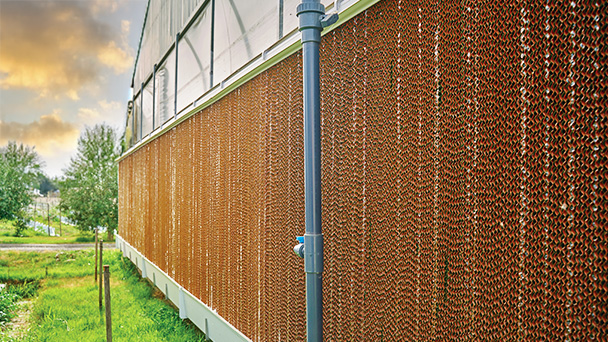
Signs that your cooling system needs maintenance
Maintenance should not be based only on a fixed calendar. The system should also be inspected whenever one or more of the following conditions occur:
- Part of the pad remains dry while the system is running
- Water does not flow evenly across the pad
- Mineral deposits are visible on the pad surface
- Algae or biological growth appears
- Water flow has decreased
- The pump operates irregularly
- The tank frequently overflows or runs at a low level
- Cooling performance has declined
- Airflow through the pads appears restricted
- Water has an unusual colour or odour
Identifying the underlying cause is important. Replacing or cleaning the pads alone may not solve the problem when the actual issue is related to water quality, filtration, bleed-off or pump operation.
Evaporative cooling pad maintenance checklist
A practical preventive maintenance programme should include:
Daily
- Inspect the pad surface
- Check for dry or clogged areas
- Clean blocked distribution holes
- Confirm uniform water irrigation
- Verify continuous bleed-off operation, where installed
Weekly
- Complete all daily checks
- Inspect the float valve and water level
- Clean the pump filter
- Check pump operation
- Replace recirculating water when continuous bleed-off is not used
Quarterly
- Complete all daily and weekly checks
- Switch off pumps and fans
- Allow the pads to dry
- Drain tanks and gutters
- Brush away deposits with a non-metallic brush
- Refill and rinse the pads for at least 45 minutes
- Drain the rinsing water and refill with fresh water
The appropriate frequency may need to be increased depending on climate, water quality, dust levels and system utilisation.
Protect cooling performance through preventive maintenance
CELdek® cooling pads are one part of a complete evaporative cooling system. Their performance depends on proper interaction between the pads, water distribution equipment, pumps, filters, gutters, bleed-off system and ventilation equipment.
Routine inspections and correct water management help:
- Maintain uniform pad wetting
- Preserve airflow through the system
- Limit mineral and algae accumulation
- Reduce unplanned maintenance
- Support consistent cooling performance
- Extend the useful life of system components
A maintenance plan should always reflect the conditions of the individual installation. Water quality, system configuration, operating hours and environmental conditions can all influence the required maintenance frequency.
Need support assessing your evaporative cooling system?
Contact our technical team for guidance on CELdek® cooling pads, water distribution systems and preventive maintenance practices for your installation.
Request information on products and applications